

Can You Stain Particle Board?
Particle Board is widely used for furniture cores, interior fixtures, and cost-efficient panels, but staining is often misunderstood. The short answer is that particle board can be stained only under specific conditions, and the result depends heavily on the surface type. Raw particle board absorbs stain unevenly and can swell if moisture penetrates. Laminated, melamine-faced, or veneered particle board behaves differently, and in many cases staining is not the best finishing method unless the panel is designed for it.
At KIM BONG WOOD, we help buyers choose particle board specifications based on the intended finishing route, including stain-like wood appearance, paint systems, lamination, and veneering. For product options and technical specifications, refer to: Particle Board
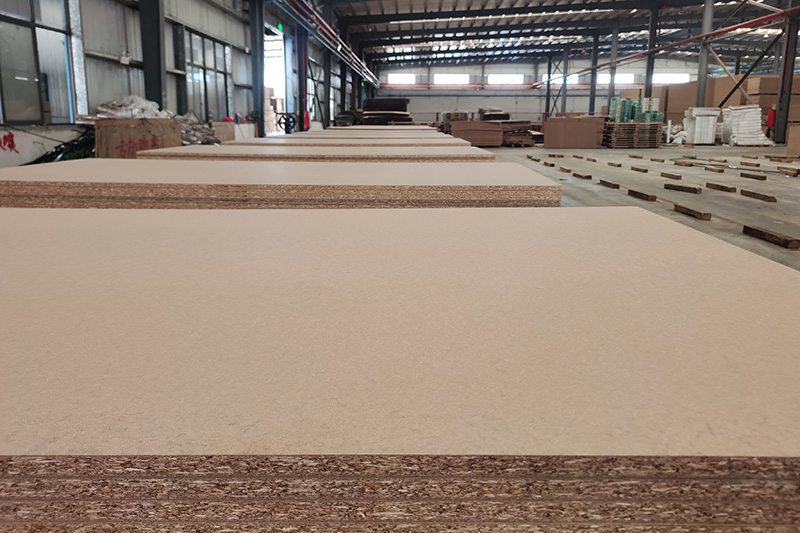
Particle Board Surface Types And Stain Compatibility
Whether you can stain particle board depends on what you are actually staining. Particle board products are commonly supplied in several surface formats, and each one responds differently.
Raw unfinished particle board
This surface is porous and inconsistent. It absorbs stain quickly, often creating dark patches and uneven tone. The panel edges are even more absorbent and may swell.Veneered particle board
A real wood veneer layer can be stained similar to solid wood, provided the veneer thickness supports sanding and preparation. This is the most stain-compatible route.Melamine-faced or laminated particle board
These surfaces are sealed and do not absorb stain. Staining does not bond reliably and usually results in poor durability.Primed or pre-finished board
These products are designed for paint or overlay systems rather than stain penetration.
A stain-ready outcome usually requires either a veneer surface or a controlled overlay designed for stain-like finishing.
Why Raw Particle Board Does Not Stain Like Solid Wood
Stain works by penetrating into wood fibers. Solid wood has relatively continuous grain structure, while particle board is made of wood particles and resin, creating a surface with variable density and porosity.
Common staining issues on raw particle board include:
Blotching due to uneven absorption zones
Dark edge lines because edges absorb faster than the surface
Raised fibers and roughness after wet stain application
Swelling and thickness change if the board takes on moisture
Weak durability because the stained surface remains porous
For projects that require a wood-tone appearance, a veneer layer or a decorative overlay is often more controllable than direct staining.
When Staining Particle Board Makes Sense In Production
Staining can be reasonable when the panel is built for it or the finishing goal is aligned with the material reality.
Staining is most practical in these cases:
Veneered particle board where the top layer is real wood
Sample or prototype builds where visual uniformity requirements are lower
Low-contact decorative applications where the surface will be sealed with a strong topcoat
Interior dry environments where moisture exposure is controlled
In most commercial programs, the preferred route is to specify the panel surface for the required look rather than forcing stain onto an incompatible surface.
Preparation Steps For Better Stain Results
If staining is required, preparation is the difference between acceptable and unusable results. The key is to control absorption and protect vulnerable edges.
Best-practice preparation:
Sand lightly to smooth the surface without breaking structure, focusing on leveling rather than aggressive removal
Seal edges with an appropriate sealer or filler because edges are the highest-risk absorption points
Apply a conditioner or pre-seal coat to reduce blotching on raw surfaces
Choose a stain system with controlled moisture content and predictable penetration
Plan a test panel process because small changes in sanding and sealing affect the final tone
For veneered boards, preparation should protect the veneer thickness. Over-sanding can cut through the veneer, creating irreversible defects.
Finishing Systems That Work Better Than Stain
Many buyers want a stained wood look, but what they actually need is repeatable color and durable performance. For large programs, alternative finishing routes often provide better consistency.
Common alternatives:
Veneer with stain and topcoat
This delivers true wood appearance with better control.Decorative paper overlay and lamination
This provides a consistent wood tone and stable surface durability.Paint and color systems
Better for solid colors and high-wear surfaces.PVC or film wrapping
Useful for complex profiles and moisture-sensitive environments.
Finish route comparison
| Finish Goal | Recommended Surface | Reason |
|---|---|---|
| Natural wood tone with depth | Veneered particle board | Stain acts on real wood fiber |
| Highly consistent wood pattern | Laminated surface | Pattern and tone are controlled |
| High durability and easy cleaning | Melamine surface | Sealed, wear-resistant face |
| Solid color furniture | Primed board for painting | Controlled base for coatings |
Selecting the right surface specification is usually more cost-effective than trying to correct stain behavior later in production.
Specification Points For Large-Scale Projects
For project deployment, staining feasibility must be evaluated with specification control rather than workshop trial only. Key parameters include:
Surface type
Veneer, raw, laminated, or melamine-faced determines finishing options.Board density and internal bond
Higher stability improves machining and finishing consistency.Thickness and edge treatment
Edges require special control for staining and sealing.Moisture exposure expectation
Stained finishes require strong sealing and dry-use assumptions.
For a project buyer managing multiple SKUs or repeated replenishment, matching the panel to the finishing route reduces defects, increases yield, and stabilizes appearance across production runs. This is especially important in OEM/ODM programs where repeatable color is a specification rather than a preference.
For product options and technical specifications, refer to: Particle Board
KIM BONG WOOD Support For Finishing-Oriented Panel Selection
KIM BONG WOOD supplies particle board solutions that support different finishing routes, including veneering, lamination, and paint-ready systems. We help customers align board construction and surface format with the intended appearance and performance requirements so finishing becomes predictable at scale.
Our support commonly includes:
Panel specification matching based on finishing method and environment
Customized sizes and packaging to improve processing efficiency
Stable supply planning for phased production and multi-site deployment
Technical guidance to reduce common finishing defects and improve yield
For wholesale procurement, consistent board quality and clear surface specification are the foundation for stable finishing performance.
Conclusion
Yes, particle board can be stained, but the result depends on the surface type. Raw particle board stains unevenly and is moisture-sensitive, while veneered particle board can be stained effectively because the stain interacts with real wood fiber. Laminated and melamine-faced surfaces are not suitable for staining because they do not absorb stain reliably. For most production programs, the most reliable approach is to specify a stain-compatible surface such as veneer, or choose an alternative finish route that delivers a consistent wood-tone appearance.
If you are planning a furniture or interior panel program and need a finish-ready particle board specification, KIM BONG WOOD can support selection, customization, and bulk order supply. Share your target appearance, panel size, thickness, and finishing method, and we will recommend suitable particle board options and provide a quotation for your inquiry.
Previous: How To Fix Particle Board?