

Why Leading Furniture Makers Prefer Chipboard Over Plywood for Fast, Flat-Pack Production?
Speed has become a defining factor in furniture manufacturing. Flat-pack production depends on panels that are easy to process, stable in size, and consistent across large volumes. In this context, many furniture makers are moving away from plywood and choosing furniture Particle Board as a more practical solution.
This shift is not only about cost. It is about how materials behave in real production lines.
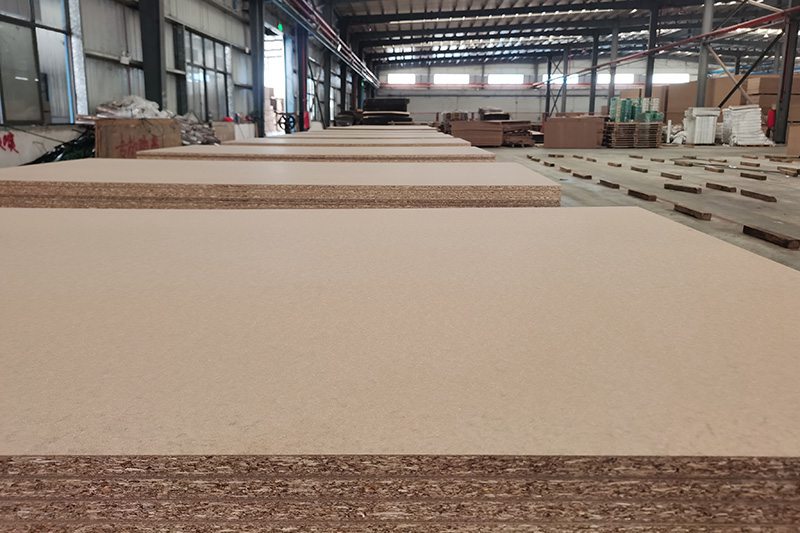
Why Chipboard Fits Flat-Pack Manufacturing Better
Flat-pack furniture requires precision. Panels need to be cut, drilled, edged, and assembled with minimal variation. Even small inconsistencies can slow down production or affect final assembly.
Chipboard offers a more uniform internal structure compared to plywood. That uniformity makes machining more predictable. Cutting is cleaner, drilling is more stable, and hardware installation becomes easier to standardize. For factories running high-volume orders, this consistency reduces adjustment time on machines and improves overall efficiency.
In contrast, plywood layers can sometimes create uneven resistance during processing, which requires more control and experience on the production floor. For fast-moving production lines, that difference becomes noticeable.
Why Surface Quality Matters More Than Strength
In many furniture applications, especially wardrobes, cabinets, and shelving systems, surface finish plays a bigger role than structural strength alone.
Chipboard provides a smooth and even surface that works well with laminates, veneers, and decorative coatings. This helps manufacturers achieve a more consistent finish across large batches. It also simplifies the finishing process, which is important when production timelines are tight.
With furniture particle board, the focus is not just on holding structure, but on delivering a clean surface that supports modern furniture designs. This is particularly valuable for flat-pack products that rely on visual consistency to meet market expectations.
Cost Control Without Sacrificing Production Flow
Material cost is always a concern, but in large-scale furniture production, hidden costs matter just as much. These include processing time, material waste, and production delays.
Chipboard helps control these factors by offering stable density and predictable performance. It is easier to handle in cutting and shaping, which reduces waste and speeds up throughput. For manufacturers managing bulk orders, this kind of efficiency directly affects profitability.
This is one of the reasons furniture particle board is widely used in furniture supply chains. It allows manufacturers to maintain competitive pricing while keeping production stable.
Supporting OEM And Bulk Supply Needs
For OEM and ODM projects, consistency across orders is critical. Buyers expect the same specifications, surface finish, and performance from one shipment to the next.
Chipboard supports this requirement well. Its standardized structure makes it easier to maintain uniform quality across batches. This helps suppliers meet the expectations of importers, wholesalers, and project buyers who rely on repeat orders.
Flexible specifications, including different thickness options and surface finishes, also make it easier to adapt the material to different furniture designs. This is especially useful for private label programs and large-scale furniture collections.
A Practical Choice For Modern Furniture Production
The preference for chipboard over plywood in flat-pack furniture is not a trend by accident. It reflects how furniture manufacturing has evolved. Speed, consistency, and cost control now play a bigger role than traditional material preferences.
Furniture particle board aligns well with these priorities. It supports efficient processing, stable quality, and scalable production. For manufacturers and buyers working in fast-moving markets, it offers a more practical balance between performance and cost.
Conclusion
Flat-pack furniture production requires materials that work smoothly across every stage, from machining to assembly to final presentation. Chipboard has proven to be a reliable choice in this environment because it delivers consistency, efficiency, and surface quality where it matters most.
If you are planning a new furniture project or reviewing your current material options, you can share your requirements with us. We can help you find a suitable board solution based on your production needs and supply expectations.